








Recent Public Posts - [guest]
| Re: Spain - 69 dead after two trains collide south of Madrid - 28 October 2026 In "The Wider Picture Overseas" [381465/32669/52] Posted by Chris from Nailsea at 17:20, 30th October 2026 |      |
From the BBC:
Spain transport minister says he won't resign over high-speed rail disaster
Spain's transport minister says he won't resign over the high-speed rail collision that has left at least 69 people dead.
Óscar Puente told a news conference in Madrid he had "nothing to hide" while repeating the government's vow to get to the bottom of the disaster, saying many questions needed to be answered. "My duty right now is not to talk about whether I should remain in my position, but to resolve the problem," Puente said.
The transport minister has been facing calls to step down in the aftermath of the tragedy, including from political rivals, a trade union and demonstrators who protested outside the transport ministry on Wednesday night.
Dozens were killed and many more injured when a state-operated Renfe high-speed train smashed into the back of another stationary train operated by the Iryo company near the town of Urda, in the central Toledo province, on Wednesday morning.
A preliminary report released by transport investigators late on Thursday found the Renfe train was travelling between 160km/h (99.4mph) and 200km/h when the collision occurred, causing its front carriage to become embedded in the tail of the stationary train.
Spanish Prime Minister Pedro Sánchez said earlier on Friday that public trust in Spain's high-speed rail network had been broken and repeated it was "unacceptable" that there had been two similar tragedies within a year.

Image © AFP via Getty Images
In January a collision on the same Madrid-Seville route killed 46 people in Adamuz in southern Spain.
Wednesday's tragedy was one of the worst rail disasters in Europe's modern history, and Spain's worst crash since 2013.
Puente said on Wednesday a computer failure at about 08:30 that morning led to the initial halt of six moving trains, including the two trains that subsequently collided.
Leaked audio recordings published in Spanish media revealed conversations between train drivers and a control centre just minutes before the crash.
Three audio recordings between Madrid's control centre and two train drivers appear to show that one high-speed train was given clearance to move even though another train had stalled on the track, about 25km (15 miles) ahead.
Puente had said that the decision to instruct the trains to move again, without any speed restrictions, was "inexplicable".
The leaking of the audio recordings has been criticised by some Spanish politicians, with Alberto Ibáñez, a member of Congress for the left-wing Sumar platform, writing on X that they were "despicable".
Meanwhile, Irene Montero - the prime ministerial candidate for the left-wing Podemos party - said responsibility for the crash should not be placed on one worker, adding that train drivers and experts have been warning against the liberalisation of the railway sector for years.
(BBC article continues)
Spain's transport minister says he won't resign over the high-speed rail collision that has left at least 69 people dead.
Óscar Puente told a news conference in Madrid he had "nothing to hide" while repeating the government's vow to get to the bottom of the disaster, saying many questions needed to be answered. "My duty right now is not to talk about whether I should remain in my position, but to resolve the problem," Puente said.
The transport minister has been facing calls to step down in the aftermath of the tragedy, including from political rivals, a trade union and demonstrators who protested outside the transport ministry on Wednesday night.
Dozens were killed and many more injured when a state-operated Renfe high-speed train smashed into the back of another stationary train operated by the Iryo company near the town of Urda, in the central Toledo province, on Wednesday morning.
A preliminary report released by transport investigators late on Thursday found the Renfe train was travelling between 160km/h (99.4mph) and 200km/h when the collision occurred, causing its front carriage to become embedded in the tail of the stationary train.
Spanish Prime Minister Pedro Sánchez said earlier on Friday that public trust in Spain's high-speed rail network had been broken and repeated it was "unacceptable" that there had been two similar tragedies within a year.
Image © AFP via Getty Images
In January a collision on the same Madrid-Seville route killed 46 people in Adamuz in southern Spain.
Wednesday's tragedy was one of the worst rail disasters in Europe's modern history, and Spain's worst crash since 2013.
Puente said on Wednesday a computer failure at about 08:30 that morning led to the initial halt of six moving trains, including the two trains that subsequently collided.
Leaked audio recordings published in Spanish media revealed conversations between train drivers and a control centre just minutes before the crash.
Three audio recordings between Madrid's control centre and two train drivers appear to show that one high-speed train was given clearance to move even though another train had stalled on the track, about 25km (15 miles) ahead.
Puente had said that the decision to instruct the trains to move again, without any speed restrictions, was "inexplicable".
The leaking of the audio recordings has been criticised by some Spanish politicians, with Alberto Ibáñez, a member of Congress for the left-wing Sumar platform, writing on X that they were "despicable".
Meanwhile, Irene Montero - the prime ministerial candidate for the left-wing Podemos party - said responsibility for the crash should not be placed on one worker, adding that train drivers and experts have been warning against the liberalisation of the railway sector for years.
(BBC article continues)
| Re: Bristol trams - their possible resurrection, ongoing discussion In "Bristol and Bath (WECA, now WEMCA)" [381464/24687/21] Posted by Chris from Nailsea at 16:50, 30th October 2026 | |
An interesting pictorial history item, from the BBC:
Bristol then and now: Trams, barges and rugby
In the second of our interactive galleries showing how Bristol has changed over the years we head to the edge of what is now Castle Park and then up to the other side of the centre to see how the roads looked with trams on them.
Finally we take a trip back to the home of Bristol Rugby. Not the Memorial Stadium, but nearby.
Swipe left and right to reveal how each location has changed over the decades.
There remains much debate about a possible light rail or tram system returning to Bristol. Well as this picture from June 1935 shows, it is possible to have a tram network despite the many hills of Bristol.
In 1941 the trams stopped running. Now it's just cars and other vehicle trundling up Upper Maudlin Street, where these pictures were taken.
(BBC article continues)
| Re: Worcestershire Parkway Station project - ongoing discussion In "London to the Cotswolds" [381463/16141/14] Posted by bleeder4 at 16:23, 30th October 2026 | |
https://www.worcesternews.co.uk/news/26682561.commuters-fined-park-opposite-worcestershire-parkway/
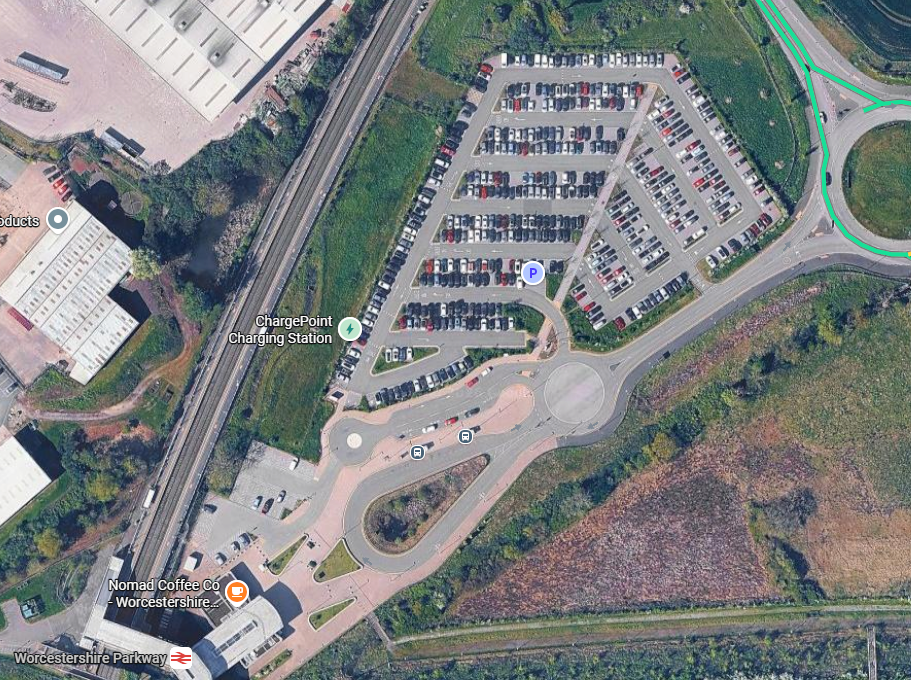
"AROUND 20 motorists were hit with Fixed Penalty Notices (FPN) near a Worcestershire railway station as cars were left parked on a grass verge. The vehicles were parked opposite Worcestershire Parkway station on Thursday, which has a 483-space long-stay car park."
There has been an issue with the car park filling up for a while now, particularly Tuesday to Thursday. Get there after 9:30 and you'll have a heck of a job finding a free space.
I do wonder if the problem has been exacerbated this week though by all the Hereford and Malvern passengers driving there to get trains to London, due to this week's engineering works.
You can see the problem with the satellite view on Google Maps. I don't know what time of day this is from, but it was clearly a weekday as I would estimate the car park is 90% full here.
| Re: Oxford Street, London has been pedestrianised In "Active travel: Cyclists and walkers, including how the railways deal with them" [381462/32663/50] Posted by TaplowGreen at 16:06, 30th October 2026 | |
Back to Oxford Street: I have wondered if provision might have been made for cyclists, such as a dedicated lane, but that would still leave the problem of riders joining it from side streets - and of pedestrians using it. My grumpiness is even-handed, and I've scowled when I've seen people walking in cycle lanes.
I think if you look at the longer term plan for Oxford Street that dedicated lanes wouldn't work, that said, if the rules aren't properly enforced (and they aren't at the moment), some cyclists will continue to create a hazard, I've seen footage of the usual clowns cycling up and down pulling wheelies in the midst of pedestrians.
Crossed Henrietta Place yesterday on way to office, buses thundering around there and apparently bus drivers are already expressing concern that there are going to be accidents - those roads and junctions just aren't designed for it.
The large community of homeless people who generally slept at the front of John Lewis on Oxford Street have been relocated to the back - not sure if they had any choice in this, but they are now forced to occupy a much narrower space.
| Re: Shortage of train crews on Great Western Railway - ongoing discussion In "Across the West" [381461/18719/26] Posted by TaplowGreen at 15:22, 30th October 2026 Already liked by Witham Bobby | |
The last few days a few shuttles (Exeter/Plymouth/Penzance) cancelled because of staff shortages.
Several 'expresses' to/from London down to 5 cars.
St Ives down to 2 cars - more trains than usual needing repairs.
Several 'expresses' to/from London down to 5 cars.
St Ives down to 2 cars - more trains than usual needing repairs.
Half term so too many staff allowed leave to maintain the service. Familiar story. Poor workforce planning.
Cotswold services suffering this afternoon/evening, 2 consecutive longer distance services cancelled.
| Re: North Cotswold line delays and cancellations - 2026 In "London to the Cotswolds" [381460/31371/14] Posted by charles_uk at 12:49, 30th October 2026 | |
11:52 London Paddington to Worcester Shrub Hill due 14:04 was terminated at Oxford.
It will no longer call at Hanborough, Charlbury, Kingham, Moreton-In-Marsh, Honeybourne, Evesham, Pershore, Worcestershire Parkway Hl and Worcester Shrub Hill.
This is due to train crew being delayed.
13:50 London Paddington to Worcester Shrub Hill due 16:00 will be terminated at Oxford.
It will no longer call at Hanborough, Charlbury, Kingham, Moreton-In-Marsh, Honeybourne, Evesham, Pershore, Worcestershire Parkway Hl and Worcester Shrub Hill.
This is due to a shortage of train crew.
14:17 Worcester Shrub Hill to London Paddington due 16:26 will be started from Oxford.
It will no longer call at Worcester Shrub Hill, Worcestershire Parkway Hl, Pershore, Evesham, Honeybourne, Moreton-In-Marsh, Kingham, Charlbury and Hanborough.
This is due to train crew being delayed.
16:17 Worcester Shrub Hill to London Paddington due 18:29 will be started from Oxford.
It will no longer call at Worcester Shrub Hill, Worcestershire Parkway Hl, Pershore, Evesham, Honeybourne, Moreton-In-Marsh, Kingham, Charlbury and Hanborough.
This is due to a shortage of train crew.
16:53 Worcester Shrub Hill to London Paddington due 19:29 will be cancelled.
This is due to a shortage of train crew.
19:53 London Paddington to Worcester Foregate Street due 22:02 will be cancelled.
This is due to a shortage of train crew.
20:52 London Paddington to Worcester Foregate Street due 23:00 will be cancelled.
This is due to a shortage of train crew.
It will no longer call at Hanborough, Charlbury, Kingham, Moreton-In-Marsh, Honeybourne, Evesham, Pershore, Worcestershire Parkway Hl and Worcester Shrub Hill.
This is due to train crew being delayed.
13:50 London Paddington to Worcester Shrub Hill due 16:00 will be terminated at Oxford.
It will no longer call at Hanborough, Charlbury, Kingham, Moreton-In-Marsh, Honeybourne, Evesham, Pershore, Worcestershire Parkway Hl and Worcester Shrub Hill.
This is due to a shortage of train crew.
14:17 Worcester Shrub Hill to London Paddington due 16:26 will be started from Oxford.
It will no longer call at Worcester Shrub Hill, Worcestershire Parkway Hl, Pershore, Evesham, Honeybourne, Moreton-In-Marsh, Kingham, Charlbury and Hanborough.
This is due to train crew being delayed.
16:17 Worcester Shrub Hill to London Paddington due 18:29 will be started from Oxford.
It will no longer call at Worcester Shrub Hill, Worcestershire Parkway Hl, Pershore, Evesham, Honeybourne, Moreton-In-Marsh, Kingham, Charlbury and Hanborough.
This is due to a shortage of train crew.
16:53 Worcester Shrub Hill to London Paddington due 19:29 will be cancelled.
This is due to a shortage of train crew.
19:53 London Paddington to Worcester Foregate Street due 22:02 will be cancelled.
This is due to a shortage of train crew.
20:52 London Paddington to Worcester Foregate Street due 23:00 will be cancelled.
This is due to a shortage of train crew.
| Re: Last trains - Carlisle v Newcastle In "The Wider Picture in the United Kingdom" [381459/32676/51] Posted by IndustryInsider at 11:45, 30th October 2026 | |
So under GBR, it could mean that any TOC (as was) could use any existing stabling depot anywhere!?
Or too fanciful perhaps.
Or too fanciful perhaps.
If it's purely for stabling, then potentially 'yes'.
But usually, cleaning, emptying of toilet tanks, 'fitness to run' certificates and light maintenance is involved as well. That requires specific facilities and equipment for the type of train concerned.
And we should remember that even when GBR is up and running, the trains (initially at least) are all owned by ROSCO's and maintenance is often tied in with the manufacturer.
| Re: Last trains - Carlisle v Newcastle In "The Wider Picture in the United Kingdom" [381458/32676/51] Posted by GBM at 11:37, 30th October 2026 | |
There could just about be a case for the 20:30 EUS-PRE to extend to Glasgow via Carlisle I guess, but surely nothing later than that would make sense. And there's no point running something just to Carlisle as the stabling/maintenance points are at Glasgow and Manchester which is why the 20:30 and 21:10 from Euston only go to Preston. The former runs empty to the depot in Manchester, the latter lays over at Preston for five hours before running empty to Lancaster to form the first London bound train next morning. That makes sense because the crew depot is at Preston so the late shift immobilise the train and the early shift then mobilise it.
By contrast, the East Coast stabling point is actually in Newcastle.
Or too fanciful perhaps.
| Re: Shortage of train crews on Great Western Railway - ongoing discussion In "Across the West" [381457/18719/26] Posted by GBM at 11:32, 30th October 2026 | |
The last few days a few shuttles (Exeter/Plymouth/Penzance) cancelled because of staff shortages.
Several 'expresses' to/from London down to 5 cars.
St Ives down to 2 cars - more trains than usual needing repairs.
| Re: Last trains - Carlisle v Newcastle In "The Wider Picture in the United Kingdom" [381456/32676/51] Posted by IndustryInsider at 11:21, 30th October 2026 | |
Why is the last train north from London to Carlisle on the West Coast Main Line at 7.30pm, while the last train to Newcastle on the East Coast leaves at 11.08pm?
Today I asked the Transport Minister whether, now the failed experiment of rail privatisation is over, the new publicly owned railway will finally give the West Coast the same evening services as the East Coast.
Today I asked the Transport Minister whether, now the failed experiment of rail privatisation is over, the new publicly owned railway will finally give the West Coast the same evening services as the East Coast.
Why?
Well, the population of Carlisle is 77,000. Population of Newcastle and Gateshead is 380,000 with over a million in the wider Tyne & Wear area.
The east coast route has Darlington and Durham as previous stops (adds another 150,000). Oxenholme (including nearby Kendal) and Penrith on the West Coast only adds another 45,000. Lancaster can be reached on the 20:30 with a change at Preston.
There could just about be a case for the 20:30 EUS-PRE to extend to Glasgow via Carlisle I guess, but surely nothing later than that would make sense. And there's no point running something just to Carlisle as the stabling/maintenance points are at Glasgow and Manchester which is why the 20:30 and 21:10 from Euston only go to Preston. The former runs empty to the depot in Manchester, the latter lays over at Preston for five hours before running empty to Lancaster to form the first London bound train next morning. That makes sense because the crew depot is at Preston so the late shift immobilise the train and the early shift then mobilise it.
By contrast, the East Coast stabling point is actually in Newcastle.
| Re: Last trains - Carlisle v Newcastle In "The Wider Picture in the United Kingdom" [381455/32676/51] Posted by grahame at 10:06, 30th October 2026 | |
More logical to extend the 21:10 from Euston to Preston as far as Carlisle, arrival about 1 a.m.?
According to my journey planner, the 22:03 from KX to Newcastle gets there at 01:38 - say 02:50 to Carlisle if extended.
| Re: Class 175s to Great Western Railway (GWR) In "Across the West" [381454/28982/26] Posted by grahame at 09:04, 30th October 2026 | |
103+110 (the Green ones) have been on a siding next to the shed in Laira since arriving on 1 October 2026.
There seems to be no effort to get these trains in service or even move them.
One problem seems to have arisen with the 175s is one door will not open unless kicked if it is in a station with a cant.
There seems to be no effort to get these trains in service or even move them.
One problem seems to have arisen with the 175s is one door will not open unless kicked if it is in a station with a cant.
Could they be waiting for 13th December, for final preps not to be the responsibility of the TOCs shareholders, and for them to come into service at that date as a quick win for the new operator?
| Re: Last trains - Carlisle v Newcastle In "The Wider Picture in the United Kingdom" [381453/32676/51] Posted by grahame at 08:59, 30th October 2026 | |
I think it could depend on the servicing of the trains,
the last Newcastle service COULD continue to Carlisle,
BUT I presume would have to go back to Newcastle for servicing.
Distance from Carlisle to Newcastle 60 miles(journey time approx one hour)
the last Newcastle service COULD continue to Carlisle,
BUT I presume would have to go back to Newcastle for servicing.
Distance from Carlisle to Newcastle 60 miles(journey time approx one hour)
Interesting thoughts, as there was a proposal at one time to close the East Coast main line north of Newcastle with all traffic routed onward via Carlisle.
In current time, you have London to Newcastle electric but not onward to Carlisle, you have crew hours and route knowledge issues, as well as servicng and a question about who would pay for an extra service extension that late at night.
| Re: Class 175s to Great Western Railway (GWR) In "Across the West" [381452/28982/26] Posted by REVUpminster at 08:05, 30th October 2026 | |
103+110 (the Green ones) have been on a siding next to the shed in Laira since arriving on 1 October 2026.
There seems to be no effort to get these trains in service or even move them.
One problem seems to have arisen with the 175s is one door will not open unless kicked if it is in a station with a cant.
| Re: Night Riviera Sleeper train - between Paddington and Penzance - ongoing discussion In "London to the West" [381451/31911/12] Posted by Pb_devon at 07:49, 30th October 2026 | |
Today’s CRS website news section had images and notes about the ECS move. Low coolant is said to have been the problem.
https://www.cornwallrailwaysociety.org.uk/latest-input--news--old-pictures-etc
Scroll down to 30 October section.
| Re: Thames Valley infrastructure problems causing disruption elsewhere - 2026 In "Across the West" [381450/31163/26] Posted by TaplowGreen at 06:53, 30th October 2026 | |
Cancellations to services between London Paddington and Reading
Following a fault with the signalling system between London Paddington and Reading some lines towards Reading will be reopened shortly.
Train services running to and from these stations may be cancelled. Disruption is expected until 08:00 30/10.
Customer Advice
-
What has happened?
-
Some axle counters, part of the signalling system, have stopped working in the Acton area.
| Re: Last trains - Carlisle v Newcastle In "The Wider Picture in the United Kingdom" [381449/32676/51] Posted by infoman at 06:51, 30th October 2026 | |
I think it could depend on the servicing of the trains,
the last Newcastle service COULD continue to Carlisle,
BUT I presume would have to go back to Newcastle for servicing.
Distance from Carlisle to Newcastle 60 miles(journey time approx one hour)
| Re: Spain - 69 dead after two trains collide south of Madrid - 28 October 2026 In "The Wider Picture Overseas" [381448/32669/52] Posted by JayMac at 00:15, 30th October 2026 | |
Opinion piece from El Pais (Spanish newspaper English edition):
Unbearable disasters
The second deadly collision of two high-speed trains in less than a year is a blow to citizens' trust in the state
For the second time in nine months, all of Spain is stunned by images of two high-speed trains shattered on a track in the middle of the countryside, by the appalling death toll and by the harrowing accounts of survivors of a rail crash that will have its own page in history. Almost 400 people were aboard the AVE train that, at 8.53 a.m. on Wednesday, collided with an Iryo train stopped on the Madrid–Andalucía line near Urda (Toledo), which had 146 people on board. The toll of 69 dead is still provisional. The number of injured exceeds 100. In these critical hours, it is necessary to convey to those who have lost a loved one the empathy and solidarity of all of Spanish society. The testimonies of families and survivors will be the anchor to ensure the scale of this human tragedy is never forgotten.
The provisional sequence of events described by the Ministry of Transportation begins with a failure of the electronic safety system that controls traffic on the line, something that is uncommon but can happen. Six trains stopped automatically, and control of safety passed to the Atocha control center. From there, someone gave the order for the AVE to resume travel at normal speed, despite a red signal and a train stopped ahead. The collision was extremely violent. That decision, taken by an operator, is now the main enigma. Minister Óscar Puente called it an “erroneous decision” and talked about “inexplicable circumstances.” Only the caution required by a judicial investigation can justify delaying an explanation, even a preliminary one, to a country stunned by the inconceivable.
Last January, two high-speed trains collided in Adamuz (Córdoba) and left 46 dead in the worst rail disaster since Angrois (Pontevedra) in 2013. That was pointed to as a turning point in the development of Spain’s high-speed network, a decades-long project that has won Spain worldwide recognition as a leader in transportation infrastructure. The subsequent reflection affected every aspect of rail transportation, from safety protocols and the state of infrastructure to communication protocols, commercial liberalization and route congestion. Now Spain asks how such a tragedy could have happened again on high-speed lines, and that collective trauma has been reopened in the most painful way. This time, without the elements of fatality and chance present in Adamuz. The crisis of confidence opening up regarding the reliability of the state is incalculable.
That is why what happened in Urda is not only a human tragedy or a rail accident. It is a catastrophe that affects citizens on a deeper level, and no analysis can avoid noting that Spain is watching images of horror while preparing to vote in a general election on November 29. All parties except [the far-right] Vox have suspended their campaigning. Citizens will judge those who put grief above campaigning, just as they notice when someone tries to ride the wave of legitimate social indignation. There is still time to bring politics into the conversation, but this is a moment for restraint and respect, for unity and responsibility.
It falls to everyone to rise to the occasion for a nation in shock that demands answers, a country that asks not only how this can happen, but how it can happen twice, in a country that has gone from feeling pride in the efficiency and modernity of its infrastructure to becoming a European exception because of the accumulation of rail tragedies in such a short time. The prime minister, Pedro Sánchez, put it into words: “It is unacceptable for a country like Spain to suffer two high-speed rail accidents in the same year.” Indeed it is, and that requires investigating what and who failed, and for there to be accountability. Transportation Minister Óscar Puente was also in charge during the Adamuz accident, and at the time he said the probability of a similar accident on Spain’s rail network was “very low, extremely low.” On Wednesday, it happened again. The demand for accountability is even greater now than it was then.
Here's a video that explains this incident based on information already in the public domain, along with background on the infrastructure, trains and control systems. It doesn't speculate on things not yet known.
| Last trains - Carlisle v Newcastle In "The Wider Picture in the United Kingdom" [381447/32676/51] Posted by grahame at 20:33, 29th October 2026 Already liked by Mark A, GBM | |
From Markus Campbell-Savours MP (for Penrith and Solway) via Facebook
Why is the last train north from London to Carlisle on the West Coast Main Line at 7.30pm, while the last train to Newcastle on the East Coast leaves at 11.08pm?
Today I asked the Transport Minister whether, now the failed experiment of rail privatisation is over, the new publicly owned railway will finally give the West Coast the same evening services as the East Coast.
Today I asked the Transport Minister whether, now the failed experiment of rail privatisation is over, the new publicly owned railway will finally give the West Coast the same evening services as the East Coast.
Hmm ... how are we doing in the South West these days? Last train to Truro, to Carmarthen?
Last week, we missed the last train from Oviedo to El Ferrol - it set off on time at 14:28. Yesterday we caught the last train from Entroncamento to Badajoz at 13:36, arriving at 17:26.
| Proper beer - reviving a 200-year-old ale recipe made in a teapot In "The Lighter Side" [381446/32675/30] Posted by Chris from Nailsea at 20:28, 29th October 2026 Already liked by MVR S&T, Witham Bobby | |
From the BBC:
Reviving a 200-year-old ale recipe made in a teapot

Jamie Allsopp (left) said the beer "started off the craft beer revolution"
The descendant of a brewer who made the first commercially successful India Pale Ale (IPA) has revived his seven-times-great-grandfather's recipe.
Samuel Allsopp created the beer in a teapot in 1822 after being challenged to make one which would last the six-month sea journey to India. Allsopp went on to help establish Burton-upon-Trent, Staffordshire, as the world's brewing capital.
Steve Holt, owner of Kirkstall Brewery in Leeds, found the leather-bound brewery ledger containing the recipe and teamed up with Allsopp's descendent Jamie Allsopp to remake what they called "one of the most important beers in brewing history."
Jamie said: "It started off the craft beer revolution. I'm really looking forward to drinking it with publicans and customers. It's going to be fantastic."
Allsopp's India Pale Ale was released in 70 pubs across the country on Friday, including Burton Bridge Inn and The Roebuck Inn, returning the beer to its original hometown.
In the year it was first released, the trade in sending beer to India was dominated by London brewer George Hodgson, but pale ale had become unreliable and unable to make the journey unspoiled.
Jamie, a ninth-generation family member, resurrected Allsopp's in 2021.
Recalling the IPA's history, he told the BBC: "Samuel was asked by the East India Company to brew a beer that would last the arduous six-month journey to India, as all other beers were arriving in bad condition. Samuel Allsopp did something hitherto unknown, he upped the alcohol and hop content which both act as preservatives. It really dialled it up strongly, and it was a really bitter beer. At the time it wouldn't have been drinkable straight out of the brewery, but after the six months at sea going down the Cape of Good Hope, it mellowed and arrived in India in really good condition."
This journey formed the humble beginnings of the popular ale. To save time and ingredients, Samuel and his head maltster, Job Goodhead, used a teapot to brew the first IPA and helped pioneer a new taste.
After growing into what has been described as one of Britain's great brewing empires, Allsopp's fortunes began to turn and the family lost control of the business in the 1930s.
(BBC article continues)
| Hundreds of GP practices lose online services after collapse of tech firm In "The West - but NOT trains in the West" [381445/32674/31] Posted by Chris from Nailsea at 19:25, 29th October 2026 | |
From the BBC:
Hundreds of GP practices lose online services after collapse of tech firm
Patients in many parts of the country have been left unable to access their GP surgery online after a tech firm went into administration.
Silicon Practice ran digital services, including websites, online booking and consultations, for around 500 practices in England – just under 10% of the total.
Practices across the country, including in London, Gloucestershire and Norfolk, have reported problems. Services in Wales are also affected.
GP leaders said the problem would cause huge disruption, given the scale of online booking that now takes places.
Patients in areas that are affected are being advised they will have to make appointments via the phone. The NHS app is working.
Since last year, all practices in England have had to offer online appointment booking. Currently, more than 40% of appointments are made that way.
An NHS England spokesperson said while "the majority" of GP practice websites were running as normal, some using Silicon Practice will be affected. "If your GP practice website is unavailable and you need help, you should contact your practice by phone or in person as usual."
(BBC article continues)
| Re: Railway bridges struck by road vehicles - many incidents, ongoing discussion In "The Wider Picture in the United Kingdom" [381444/8910/51] Posted by Chris from Nailsea at 18:50, 29th October 2026 | |
Yet another incident. From the BBC:
Watch the moment bridge hit at least 45 times is driven into again
A railway bridge considered the "most bashed" in Wales, having been struck almost 50 times, has been hit again.
In 2020 Network Rail said Trafle Mill bridge in Gowerton, Swansea, had been hit 33 times in the preceding decade, the most of any bridge in Wales and the border areas. There have been 12 reported strikes since 2023.
Despite sensors being installed to alert drivers of the height restrictions, CCTV footage shows a utilities lorry with wooden poles and a crane arm colliding with the bridge on 25 October.
Swansea council said it was disappointing and the warning system was functioning normally. It urged delivery companies to remind drivers of the restrictions.
In the footage, the lorry appears to slow just as it approaches but the crane arm smacks into the underside of the 11ft (3.3m) bridge, causing a loud bang.
According to residents the driver reversed onto nearby Fairwood Terrace and then headed back on Victoria Road in the opposite direction.
(BBC article continues)
| Escalator problems at Angel - to become exit only at weekends In "Transport for London" [381443/32673/46] Posted by grahame at 18:22, 29th October 2026 | |
From The Metro
Angel Station in Islington sees almost 12,000,000 visitors each year.
But the Northern Line station, which boasts the longest escalators on the London Underground network, will become exit-only so engineers can work on extending the working life of the escalators.
In April, one of the bustling transport hub’s three 200ft escalators failed, and TfL now predicts the second could soon suffer a similar fate – a failure that could force the entire closure of the station.
The third of the 35-year-old escalators is also in need of an upgrade, according to the transport body.
The exit-only restrictions, which affect the station only on weekends and bank holidays, will be introduced on January 2, 2027, until further notice.
Analysis by TfL confirms that more people leave the station than enter it on weekends and bank holidays.
According to The Standard, TfL is exploring ways to repair or replace the escalators, but due to ongoing funding pressures limiting its options, engineers are focused on keeping the escalators running for as long as possible.
How long should an escalator last? Angel was the closest tube station to my Uni / use it from time to time; it was a narrow platform between the two running lines in those days ...
| Re: North Cotswold line delays and cancellations - 2026 In "London to the Cotswolds" [381442/31371/14] Posted by charles_uk at 18:09, 29th October 2026 | |
17:04 Didcot Parkway to Evesham due 18:23 will be terminated at Oxford.
It will no longer call at Hanborough, Combe, Finstock, Charlbury, Ascott-Under-Wychwood, Shipton, Kingham, Moreton-In-Marsh and Evesham.
It is being delayed between Culham and Radley and is now expected to be 16 minutes late.
This is due to a late running train being in front of this one.
18:51 Evesham to Oxford due 19:50 will be cancelled.
This is due to a late running train being in front of this one.
| Re: Transfer of historic railway estate to GBR (aka full circle) In "Looking forward - the next 2, 5, 10 and 20 years" [381441/32667/40] Posted by grahame at 18:05, 29th October 2026 Already liked by Western Pathfinder, Oxonhutch | |
Covered on
Rail UK
Campaigners have welcomed a Government commitment to hand the custodianship of 3,100 legacy bridges, tunnels and viaducts to Great British Railways, the body expected to take over the operation of most of Britain’s rail infrastructure and passenger services next year.
Collectively known as the Historical Railways Estate, the structures were transferred to the Department for Transport in 2013 after British Railways Board (Residuary) was abolished as part of a quango cull. Day-to-day management responsibilities were passed to the Highways Agency, now called National Highways, which looks after the UK’s strategic road network.
In 2021, the state-owned company was embroiled in controversy after plans were revealed that would have resulted in 134 historic bridges and tunnels being infilled or demolished without any consideration of their social value or repurposing potential. The longer-term programme could have seen as many as 480 structures being lost.
Accusations of “cultural vandalism” were levelled against National Highways after it unlawfully infilled a masonry arch at Great Musgrave in Cumbria under misapplied permitted development rights, ignoring a request from the local planning authority not to start the work.
The Government intervened to pause NH’s infilling and demolition programme ... continues
Highways England never felt look a good home for the Historic Railway Estates. One or perhaps two cheers but not three from me - responsibility is transferred to another organisation which is a successor to one that is - err - has an imperfect record - the Pilning footbridge scandal, for example.
| Re: World Cup of Stations, 2025 In "Media about railways, and other means of transport" [381440/30596/49] Posted by grahame at 17:51, 29th October 2026 | |
And for 2026, from the Warrington Guardian
Irlam station, just down the line from Warrington, was crowned the 2026 World Cup of Stations champion after securing 4,786 public votes in the competition.
The award celebrates stations that bring people together and make a positive difference in their communities.
The award celebrates stations that bring people together and make a positive difference in their communities.
| Re: Night Riviera Sleeper train - between Paddington and Penzance - ongoing discussion In "London to the West" [381439/31911/12] Posted by bobm at 17:08, 29th October 2026 | |
Looking at Real Time Trains a light loco came up from Laira and a short while later there was an ECS move back to Laira. Whether that was the sleeper stock I cannot tell.
| Re: Multiple stabbings on a London bound train in Cambridgeshire - 1 Nov 2025 In "The Wider Picture in the United Kingdom" [381438/31017/51] Posted by Chris from Nailsea at 17:05, 29th October 2026 | |
From the BBC:
Jury shown CCTV of train staff using frying pan in defence
CCTV footage of a member of train staff using a frying pan to stop a man accused of attempting to murder 10 passengers has been shown in court.
Prosecutor Christopher Paxton KC said Samir Zitouni showed "sheer courage and bravery in seeking to save lives and defend others" during the mass stabbing on the Doncaster to King's Cross train.
Jurors at Cambridge Crown Court saw footage of Zitouni using the frying pan against Anthony Williams before the train made an unscheduled stop at Huntingdon railway station on 1 November last year.
Williams, 33, of Langford Road in Peterborough, denies 14 counts of attempted murder, including incidents in Peterborough and London the day before.
(BBC article continues)
| Re: Spain - 69 dead after two trains collide south of Madrid - 28 October 2026 In "The Wider Picture Overseas" [381437/32669/52] Posted by ChrisB at 14:52, 29th October 2026 | |
God forbid that the rear train's driver was given the OK to proceed past a read light at normal speed, without a chance of stopping on seeing the rear of the stopped train. Poor b*gg*r paid for that with their life....and that of the train manager.
| Re: Landline switchover could cut people off in emergency, minister warned In "The West - but NOT trains in the West" [381436/32670/31] Posted by Clan Line at 14:07, 29th October 2026 Already liked by Mark A, GBM | |
The down side to the VOIP via FTTC or FFTH (Full Fibre to the Home) is during a power cut you loose your landline capability.
True, also if you lose your broadband (BB) service - as I did (for 4 days) a couple of weeks after changing my ISP !!
I had already given up my landline - the only calls I seemed to get were from salesmen !
If I am not teaching my Granny to suck eggs................ a couple of tips - obviously, if you have reasonable mobile signal or BB at the time.
1. When I lost my BB it only took me a few minutes to set my smart phone up as a "hotspot". Worked absolutely fine for general use. Didn't try to use it for watching 4K movies or the like, but fine for some general browsing, email and reading on line newspaper. I paid my mobile provider £5 for another 5Gb of data - as I didn't have much in my 'phone package to start with. Was using my PC set-up exactly as I would with full BB service.
2. I often turn my mobile to "aeroplane mode" when I am at home - it then uses the BB line which gives a much better signal than the mobile network - but don't forget to switch back to normal when you go out.
